
This page describes alternative voting systems for single-winner
elections in which voters are given more than just a single choice
vote. When implemented properly, ranked choice voting can have
significant advantages over traditional voting:
Consider a simplified scenario in which voters are electing a single candidate purely based on their preference on a single ideological dimension or policy. The voter popularity over a range of policy positions is drawn as a bell shaped curve, and candidates are arranged under the curve depending on their specific policy. If there are only two candidates, A and B, the one with the closest policy to what the majority wants (B) will win:
However, if a third candidate C is included, votes are taken away from the most similar candidate B, which can cause the opposite candidate A to win instead:
This is not ideal, because B is actually still preferred over A by a majority of voters.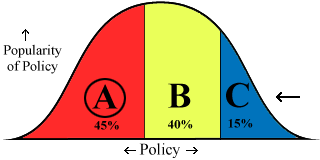
Sometimes voters may anticipate this "spoiler" effect, and avoid voting for C even if that would be their first choice. This is also unfortunate. It can strongly discourage third candidates and third parties, and could prevent desirable change in general.
Ranked choice voting can help solve these problems.
For three candidates, ranked choice ballots would simply allow both a first choice and a second choice vote:
1st 2nd
[x] [ ] The candidate you really want.
[ ] [x] The candidate you prefer if your 1st choice doesn't win.
[ ] [ ] The candidate you don't want.
In the example above where A, B, C receive 45%, 40%, and 15% of 1st choice votes, C would be eliminated after the first round. A second round of calculation would compare A and B alone in a runoff. For those voters that had C as their 1st choice, their 2nd choice votes are now used instead, so B would presumably become the final winner.
Ranked choice ballots can be extended for any number of candidates,
allowing voters the option of ranking all the candidates in order of
preference. Voters who don't have the patience to indicate more than
their first or first few choices can just abstain from the additional
choices.
In this example with 5 candidates, using traditional plurality voting the candidate (A) with the largest number of votes wins, even if most voters would actually prefer another candidate:
Using Instant Runoff Voting, B would be eliminated after the first round with only 10% of 1st choice votes. Then D and E might be eliminated on the next two rounds, leaving A and C in the last runoff, and finally C as the winner.
Of course in the real world, policy preferences are not one dimensional, and many other factors contribute to the fairness or unfairness of election results. But the only obvious disadvantage of ranked choice voting seems to be the slightly more involved technique for voting and counting the votes. In any case, for most measures of fairness, this method should always give an equal or more correct result than single choice voting.
Another method for determining a winner using ranked choice voting was originally proposed by the French mathematician Marquis de Condorcet in the 1700s. When votes are collected, instead of just counting 1st choice votes, the winners between all pairs of candidates are determined. In the first example above with 3 candidates, the voters with C as the 1st choice would probably have B as their 2nd choice, so:
If B ran alone against A: the winner would be B.B is the winner of all of their pairwise matches, so B is declared the overall winner.
If B ran alone against C: the winner would be B.
If A ran alone against C: the winner would be A.
The voters' preferences are available for each of these one-on-one matches because of the 2nd choice votes. For a given pairwise match, if a voters 1st choice was not assigned to either candidate of that pair, the 2nd choice is used instead. When B is matched against A, any 1st choice votes for C are discarded and the 2nd choice votes of those voters are used instead, so B effectively reclaims the votes that would have been theirs if C had not run.
For additional candidates, a grid can be constructed that shows who the winners would be if any one candidate ran against any other. For the example above with 5 candidates it might look like this:
For each one-on-one match, each voter's vote is given to whichever candidate is ranked above the other in that voter's list of choices. There should normally be one candidate that wins all of their pairwise competitions. In this case C is the winner. That is closest to what the majority actually prefers even though C might not have received the maximum number of 1st choice votes.
In theory with Condorcet's method there is a chance that the "majority" can be in conflict with itself and create a cycle of preferences, such as: A defeats B, B defeats C, but C defeats A. This should not happen often in practice, but in case it does, a rule is needed to select the winner from the subset of candidates in that cycle. This is an annoying side-effect of Condorset's method that complicates any complete description of the procedure.
Then, these matrices are simply summed for all voters to give the final result. For an example population of 10 voters, the matrix of sums might look something like this:
A B C D A - 1 1 1 (A is preferred over all) B 0 - 1 1 (B is preferred over C and D) C 0 0 - 1 (C is preferred over D) D 0 0 0 -
This single matrix contains the results for all the one-on-one matches. For example row C shows that C defeats A by 7/10, defeats B by 6/10, and defeats D by 8/10.
A B C D A - 3 3 4 B 7 - 4 6 C 7 6 - 8 D 6 4 2 -
On the other hand, there are some reasons that IRV may be more practical than Condorcet's. IRV is closer to the traditional plurality voting that the public is used to. Passing the change to IRV is probably more likely than passing a larger change to Condorcet's method. Condorcet's method may be perceived as complex, especially when a method for dealing with cycles is considered. If it is difficult for the public to understand, it will be seen as a risky change. Another concern is that Condorcet's might sometimes cause little-known candidates to win even with low numbers of "core" supporters or 1st choice votes. Condorcet's has also seen very little testing so far, whereas IRV has been used successfully in real elections.
See the Wikipedia pages on Instant Runoff Voting and Condorcet's Method.
See also Accurate Democracy by Robert Loring for a discussion of the best voting methods and free software.
Follow the links above to learn more about various alternative voting systems and initiatives, including IRV, Condorset's Method, and Proportional Representation.
Contact your local and national congress people and let them know you support voting reforms including Ranked Choice Voting.
Include links on your web site to this and/or other appropriate web pages.
Join The Center for Voting and Democracy to keep up to date on current voting initiatives.
© 1999, Karl Sims. All rights reserved. (Updated in
2020 and renamed from "Second Choice Voting" to "Ranked Choice
Voting")